

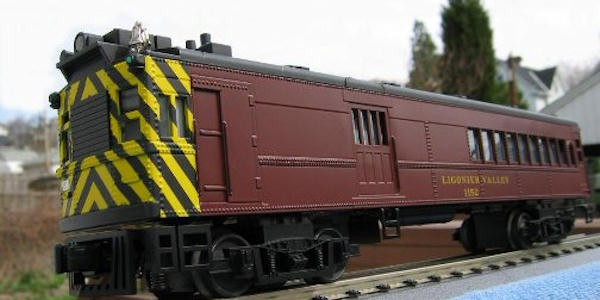
Ligonier Valley Rail Road Newspaper Articles
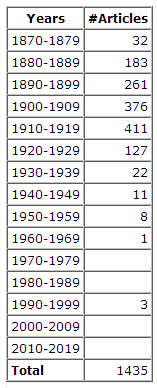 We have compiled over 1,400 newspaper articles that mention the Ligonier Valley Railroad, or related subjects. The articles were originally published starting in 1873 and our collection runs through 1995. Enjoy!
Latrobe Bulletin
Thursday, June 30, 1994
140th Anniversary Commemorative Edition
RR Line Connected Ligonier, Latrobe
When the Ligonier Valley Railroad made its last run August 31, 1952, it marked the end of an era. Never again would the "Millionaire's Line" make the run from Latrobe to Idlewild Park, carrying picnickers to the resort.
The Ligonier Valley Railroad was started when a group of businessmen in the Ligonier area felt that a rail line connecting their businesses in Ligonier with the Pennsylvania Railroad depot in Latrobe was a good idea.
The line was chartered as the Ligonier and Latrobe Railroad Co. in 1853, but there was almost a 30-year delay before the first trains would make the run from Ligonier to Latrobe, where passengers could transfer to the Pennsylvania Railroad and travel anywhere in the country.
Because of money reasons, progress on the road was slow. Between 1866 and 1871, there were several petitions to extend the time for completion of the line. During this time, also, the name was changed to the Ligonier Valley Railroad.
In 1871, the uncompleted railroad's charter rights were bought by Judge Thomas Mellon for about $5,000. Mellon invested $50,000 to finish the road, and turned its management over to his sons Richard and Andrew Mellon. Under their management, the railroad prospered over the next 10 years.
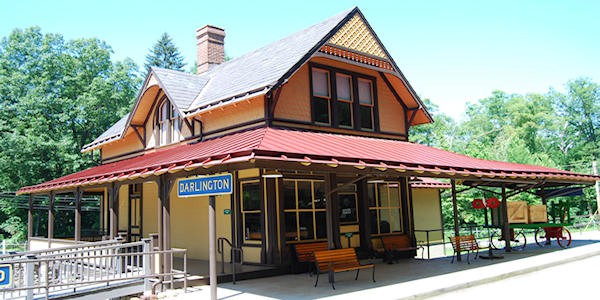
The line stretched from Latrobe to Fort Palmer, north of Ligonier, with stops (at) 12 stations, including Kingston, Darlington, Idlewild Park, Ligonier and Wilpen. It was
originally constructed at (sic) a narrow gauge, but by 1881 was redone in standard gauge.
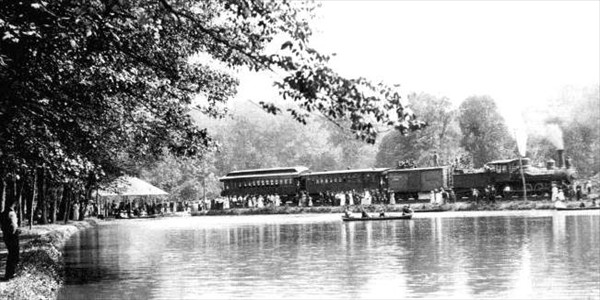
Idlewild Park was a 400-acre tract of land bought by Judge Mellon along the railroad route. He built an artificial lake and developed the area as a vacation resort. It became a popular place for church and school picnics and other outings, and added to the passenger traffic of the Ligonier Valley line.
However, most of the revenue for the line was provided by freight traffic. The mines at Fort Palmer sent tons of coal and coke along the route to Latrobe. Stone from the Long Bridge quarries was also sent along the LV line, and much of this was shipped to Pittsburgh for the use in paving the streets. Timber was another item of freight that used the line heavily for shipping purposes, along with the brick works and paper mill at
Kingston.
After the gauge was widened in 1881, the railroad used standard Pennsylvania Railroad cars and engines.
The worst disaster on the rail line was the 1912 Wilpen accident, in which a train carrying a full load of picnickers to Idlewild crashed into another train, killing 23 people,
many of the children and injuring over 40.
After World War II, shipments of coal, coke and timber diminished and eventually ceased. Coupled with the increase in automobile and bus traffic, this sounded the death knell for the Ligonier Valley Railroad.
In 1952, the railroad was abandoned, and it made its final run Aug. 31 of that year. The lines from Latrobe to Kingston were taken over by the Pennsylvania Railroad, and the other assets were sold for salvage.
Much of the old rail line was taken out and paved over for use as westbound Route 30. The rails from Kingston to Latrobe have been taken out over the last few weeks. Now, there is little to remind people of the days when "Liggie" made it runs through the countryside.