

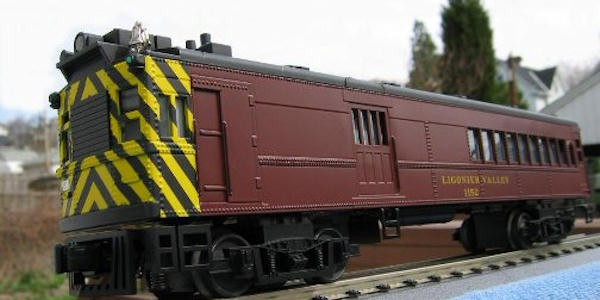
Ligonier Valley Rail Road Newspaper Articles
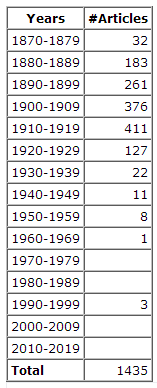 We have compiled over 1,400 newspaper articles that mention the Ligonier Valley Railroad, or related subjects. The articles were originally published starting in 1873 and our collection runs through 1995. Enjoy!
Ligonier Echo
Thursday, June 29, 1995 Blairsville, Pa.,
Loyalhanna Creek Provided Hub To Life In Kingston
By Jeff Himler
"It was a pretty ride," Peggy Clawson recalls of the train trip she took many times from the Derry Township village of Kingston to Ligonier.
Those memories are from another era, when people didn't move so fast and most residents of Kingston still preferred riding the rails to rolling down a ribbon of Highway.
Clawson is hoping to document her hometown, in conjunction with a new group being formed to preserve history throughout the Derry area.
Now 70 and a resident of nearby Clover Hill, Clawson remembers boarding the "dinky" train at the Kingston station, next to the original water works building of Latrobe's water authority.
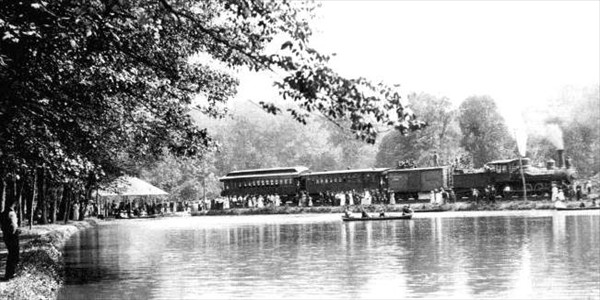
Heading east on what are now the westbound lanes of Rt. 30, the dinky followed Loyalhanna Creek, passed under the highway at Longbridge and cut through Idlewild Park, near the swimming pool.
That route would never work in today's fast paced society, where pedestrians and vehicles are a dangerous combination.
But, "I don't remember anybody ever being killed by (the train)," Clawson says. "You just had to be careful when it came through the park."
Clawson caught the train to Ligonier at 7:30 a.m. Trains would return between 2:30 and 4.
Ligonier and Kingston residents boarded a dinky going west each morning, on the first leg of a trek to Pittsburgh. They would get off at Latrobe and board a commuter train originating in Derry.
"It cost about $13 for a month's pass, still cheaper than driving to Pittsburgh."
That was in the 1940s. In the early days, people would ride a horse into town. "I could count on one hand the people who had cars when I was little."
Still, Kingston could boast of many amenities early in the century.
A succession of paper mills preceded the Kennametal plant at the intersection of Rt. 217 and Main Street extension from Latrobe, both of which were just dirt roads in Clawson's early childhood. Rt. 217 had been paved by 1932 when the family returned from a stay in Pittsburgh, where her father Joseph Andrews worked for Westinghouse.
Kingston's paper mill, which also spawned two rows of company houses, opened in 1865 under the name of the creek which bordered it, Loyalhanna. It was taken over by Peters and Co. and was rebuilt after being damaged by fire in 1879.
Roofing, manila and wrapping papers were among the products. A new plant, said to be the largest in the state, was constructed in 1902. But, it was finally shuttered in 1919.
No one worked there any longer when Clawson was a girl. But she recalls that the vacant property had a night watchman—an older man who was a well-known figure in the community and was known simply as Pappy Russ.
She can't say why a watchman was needed, since kids in that age were too strictly disciplined to consider vandalism. Clawson notes she didn't even dare to snoop around the old building, which eventually was purchased by Kennametal.
Three brickyards also ran in Kingston at various times, one owned by the Soisson family. "It was a booming town."
One thing that hasn't changed is the way the waters of the Loyalhanna, in and around Kingston Dam, attract people who want to unwind.
Swimming in the creek was a common way to pass a hot summer's day. "Back in the '30s, it was crawling with people," Clawson recalls.
There were four main areas where swimmers dipped into the water: a large cement pillar which served as a diving platform across from the paper mill; the dam itself; layers of stones piled up to form a "rock;" a sandy trail which led down to the creek in an area known as "the sand works."
Though she isn't sure what significance the name has beyond the type of soil, Clawson frequented the latter section. "It was a nice, gentle place to swim, only six to seven feet deep at the most."
She points out swimmers didn't have to take any refreshment with them, since at that time it was safe to drink directly from the Loyalhanna.
Parents weren't too worried about youngsters falling victim to a misadventure in the
creek since there was always an adult close by—Russ' wife, who was known as Mammy Russ.
"She went to the creek every day, and she swam like a fish. It's amazing when you think how many older people used to go swimming."
Of course, living close to the creek had its disadvantages, as well. During several winters, Clawson saw major ice jams as the frozen creek pile up.
When it broke, huge chunks of the ice would be thrown far past the banks of the Loyalhanna, "clear back to the paper mill." Families in the company houses considered evacuating young children and expectant mothers when the ice began to accumulate.
Slabs of ice obstructed the roads and were laboriously removed. "It would take weeks for it to melt."
Flooding on the Loyalhanna and its tributaries also was common in spring. "The creek would go up the railroad tracks, at least," Clawson says.
During the St. Patrick's Day flood on 1936, she was at her Grandmother Margaret Burd's home, a part of which is now owned by the Kingston Club. "The water came clear up to the garden."
Once cars became more commonplace, summertime entertainment included trips to a gas station and snack stand operated along Rt. 30 by Clawson's uncle, Dick Johnson.
"He sold candy bars and pop along with the gas. The kids gathered there and would take a few firecrackers to set off."
For the Fourth of July holiday, the noisemaking was prolonged, and Clawson's dog cowered in the barn for a few days.
A trip to Latrobe, on the dinky or by car, also broke up the routine. "On Saturday nights, we went to a drug store where Evans shoe store is now. I always got a chocolate soda. Then we'd sit and watch the people go by."
Patsy DiMattio attracted youngsters to his small store across from the company homes with a selection of sweets. More enticing for some of the older residents was a side room where penny ante poker was the norm.
Those Depression era days in Kingston weren't all play and no work, by any means.