


Ligonier Valley Rail Road Newspaper Articles
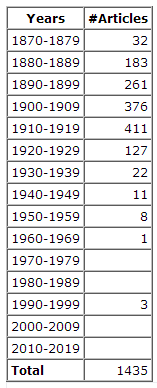 We have compiled over 1,400 newspaper articles that mention the Ligonier Valley Railroad, or related subjects. The articles were originally published starting in 1873 and our collection runs through 1995. Enjoy!
Latrobe Bulletin
Saturday, July 6, 1912
Death of Jno. Overton, Jr., Swells Wreck's Death List To 21.
All The Dead Have been Identified. Young Wife Among the Number
The inquest, he said, would be of the most thorough kind, and every effort would be made to fix the responsibility.
Coroner McMurray, Sam Morgan, who is the city editor of the Greensburg Tribune, Charles Fife, of the West Penn Company, Walter Scott, a bank cashier of Greensburg, and a chauffeur had a narrow escape from injury while coming through the ridge at four o'clock this morning, a tire having gone flat for them, in Kelly's Hollow, and they having
called the attention of the chauffeur to it, just in time to enable him to slow down to about eight miles an hour. When that speed had been reached, an axle subjected to the jar over the stones parted entirely, a defect having been existent in it. All four passengers were hurled from the car, but owing to the fact that it was going slowly, they escaped injury.
It was said by Coroner McMurray that the dispatching of trains rested with three of the
L.V.R.R. officials, R. S. Minich, the assistant superintendent; F. R. Noel, the car distributor, and T. E. People, the clerk.
A number of railroad officials are in Ligonier today holding a conference. They declined to make any statements.
Conductor Kuhn Insists That He Be Last
"Let the others be carried first," commanded Conductor Charles Kuhn, of the ill fated
train, as hospital attendants went to pick up the stretcher which bore him, following the arrival of the special train in Pittsburgh, last night.
They would have carried him among the first, but he asked that he might be the last, saying that he was all right.
Mrs. Kuhn, his wife, accompanied him to the city. She had been one of the first to reach the wreck, and was of great aid in binding up the cuts of the injured, she having used her skirt for bandages. To a Pittsburgh paper, last evening, Mrs. Kuhn made the following statement:
"This trip when the accident occurred," Mrs. Kuhn said, "was the regular 'jerk' run that goes from Ligonier, the end of the line, up to the coal mines at Wilpen. My husband brings in his regular train from Latrobe every afternoon and cuts off the combination baggage and smoking car. Then he backs up to Wilpen. He leaves Ligonier at 3:20, and when he left yesterday he was on time.
"The only other man in his crew, outside of the engineer and fireman, was the baggage master, Edward Rathmell. He wasn't badly hurt, I guess. The accident happened about a mile and a half out of Ligonier, on the coal road. I don't know how fast the train was going, but I know the engine and its car usually make fast time backing up there. The road is used mostly for coal trains, and I haven't the slightest idea why his train didn't have a clear track. It was all so terrible that I don't think anyone knows who should be blamed for it."
Had To Remove His Shoes
When Robert and Richard, brothers of the unfortunate Frank McConnaughey, labored with Charles Wilt and other rescuers in an endeavor to release the body of the dead engineer from beneath the engine which had toppled over upon him, they found it necessary to dig a trench beneath the ponderous machine in order to reach the corpse. As they worked they came across the body of a little boy, Franklin Overton, the ten year old son of John Overton, he having been caught up upon the pilot of the engine as it swept
along, a distance of nearly 200 feet until the engine fell over upon its side, crushing the boy beneath it, and its escaping steam bringing death to him, as it brought death to the engineer.
To release the body of the engineer, the brothers found it necessary to unlace his shoes, so that the feet might be drawn from them, the shoes, having been so tightly wedged beneath the mass of steel that they could not be budged.
Miss Matthews Was Heroine
Miss Esther Matthews, the trained nurse, who had her left leg and her right arm broken in the wreck, is a graduate nurse, she having been graduated from the Allegheny General Hospital, in 1908. She is a daughter of Mrs. Mary Matthews, of Chalfont street, Pittsburgh, being on of three daughters. Mrs. Matthews also has six sons, of the sons, B. I. Matthews, of Pittsburgh, being married to a daughter of Conductor Charles Kuhn. For three months or more past, Miss Matthews has been located in Ligonier, having been engaged as private nurse to General Manager George Senft, of the L.V.R.R.
Her mother, Mrs. Matthews, went to Ligonier to visit with her, Wednesday, and it was by mere chance that the mother did not accompany the daughter upon the Wilpen trains, yesterday afternoon, she having intended going along, but something having intervened.
Miss Matthews was seated near the door leading into the baggage compartment of the coach, with the children whom she had invited to go for flowers, grouped around her. She noticed the freight train bearing down upon her, and she sought to drive the children into the baggage compartment, as though to get them as far away from the oncoming engines, as possible. She was buried under a mass of wreckage, along with two of the children.
For a considerable length of time, following the accident, it could not be learned how Miss Matthews had fared, she having been unidentified, because of the cinders and the soot which covered her. Finally, she was recognized and she was one of the seven injured sent to Pittsburgh hospitals.
It is said the Miss Matthews displayed heroism, in insisting that the children along side of her be rescued first.
Declined To Make Statement
Thomas Dunlap, the veteran engineer, who was at the throttle, upon the passenger engine, was besought to make a statement, this morning, giving his views as to how the wreck had come to occur, but he declined, declaring that he would make no statement until the coroner's jury should be impaneled.
More Horrifying Than The Flood
James Love who lives near the scene of the wreck, and who viewed the carnage wrought by the freight engines declared that the spectacle was more horrifying than had been the Johnstown flood, which he had viewed. The sight was enough to turn the strongest man faint, he said, blood being everywhere, and no one left alive in all the crowd of passengers being without injuries.
Ligonier Still Dazed, Can Think Of Nothing But The Wreck
The dawn of another day found the neighboring town of Ligonier still dazed over the terrible disaster which occurred yesterday, bringing death to twenty-one and injuries to nearly thirty. Following a night that had been sleepless or filled with dreams in which mangled children played a part, the residents of the town were early astir, every one being anxious to learn the condition of the injured and the developments of the night. Upon the streets they appeared in large numbers, while questions were passed back and forth, at every step, business and household duties being suspended almost altogether,
while the men and the women and the children discussed the wreck.
Early in the morning the walk to the Lowry morgue where thirteen bodies lay cold in
death was begun and a constant stream filed in and out of the building. Telelephones were kept ringing incessantly, the wires being freighted with queries as to the condition of the living, while hundreds found their way to the homes of the stricken, there to offer their sympathy.
Each moment, almost, brought out some new detail of the disaster, rescuers having
recollected incidents which had come to their notice, and all day long, all found keenest interest in discussing the disaster.
Continued....