


Ligonier Valley Rail Road Newspaper Articles
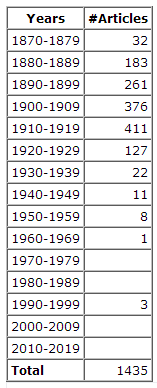 We have compiled over 1,400 newspaper articles that mention the Ligonier Valley Railroad, or related subjects. The articles were originally published starting in 1873 and our collection runs through 1995. Enjoy!
Latrobe Bulletin
Friday, September 6, 1912
Coroner Begins Investigation Of the ???
Conductor Charles Kuhn In Wheel Chair, Ready to Take the Stand. General Manager Senft Testifies
With the glistening floor and the gaily-adorned walls of a ball room for a setting, the coronerial investigation of the Wilpen branch disaster was begun, this morning, in the Ligonier-Springs Hotel. The big room which so often has been the scene of jolly occasions, took on a somber tone, as there assembled within its walls the jury, charged with the duty of due-inquiry making into the most costly wreck in Westmoreland county's history; the surviving injured, some still wearing the marks of their hurts; the railroad officials, due to be called upon to tell that which they might know; the lawyers, conscious of the interests at stake; and the people of Ligonier, more than two hundred of them, filled with suppressed emotions over the tenseness of the hour. It was not like a ball room scene.
At 10:45 o'clock. Conductor Kuhn, the veteran who was in charge of the ill-fated passenger train the day its human freight met death and injury, and. pending whose convalescence from his own grievous injuries the inquest had been long delayed, was wheeled into the hall, on an invalid's chair, he having been brought from the hospital to his home in Ligonier, yesterday, so that he might give his story to the jury. At the back
of the chair, guiding its wheels, was the conductor's devoted wife who has never been absent from his side since summoned there the day he was hurt. With her were her daughter, Mrs. I. T. Matthews, and the conductor's nurse, Miss Horsha, who is Dr. Simpson's head nurse at the Allegheny general Hospital. The conductor's right trouser leg was drawn up, exposing the bandages and cast upon a limb that was useless, while his right arm hung useless, at his side. He seemed cool and in good spirits, and responded to the greetings of the friends who gathered around his chair.
A little later, the various attorneys filed into the room, including James S. Moorhead and Edward E. Robbins, representing the L. V. R. R.; Gaither and Whitten, of Greensburg, there in the interests of some one not announced; W. N. McNair and T. Mercer Morton, both of Pittsburgh, representing in foreign consulates; John S. Lightcap, of Latrobe, there as Conductor Kuhn's personal counsel; J. N. Boucher and ex-Judge John B, Steel, of Greensburg, representing interests not made known.
It was eleven o'clock, when Coroner McMurray asked the six jurors, all Greensburg men, to arise and be sworn. The men were George Gessler, H. J. Smeltzer, W. Hunter, M. M. Moore, James W. Powell and Joseph Cherry.
The witnesses were then sworn, including General Manager George Senft, R. S. Minich, F. R. Noel, William Fortney, Conductor Charles Kuhn, Conductor Knox, a man named Jones, Mrs. Martha Keibler, John Cannon, G. Y. Rers, James St. Clair, Rothland
Fair, Justice Nicely, John Hannon and Miss Sarah E, Edsall. Several of the above were in the wreck. Others who were in the wreck were seen in the audience, including Dr. Hamill, Raymond Ankney, William Campbell and John Cosantra.
General Manager George Senft, of the L.V. R. R., was the first witness to be called to the stand. In reply to questions addressed him by the Coroner, Mr. Senft stated that he had been in the employ of the L. V. R. R.I for 31 years, and that he still was associated with the company in the capacity of manager; that the road employed 101 men; and that three trains were operated daily on the Wilpen Branch, two passengers and a freight train.
As to the Schedules.
He gave the schedules in effect both upon the Latrobe line and upon the Wilpen Branch. The Wilpen Branch freight train, he said, did not have a schedule. In speaking of the time given for the trains, the witness used the word "about," meaning thereby that the time was not always definite. The crew on the Wilpen Branch freight, he continued, was made up of a conductor, an engineer, a fireman, and four brakemen. The distance from
Ligonier to Wilpen, he said, was three and one-half miles. As to the running of the passenger train on the branch, he said that sometimes the freight crew would take it, and sometimes the Latrobe passenger train's crew, according as to which found it more convenient. The branch passenger train, he said, carried both freight and passengers, the coach being combination in its character.
There were nine sidings between Ligonier and Fort Palmer, he said, one being located in North Ligonier, and the next one at Fort Ligonier, a short distance farther on.
The company possesses no telephone, telegraph or any other method of communicating orders from the Fort Palmer end to Ligonier, stated the general manager, with the exception that the company had arranged with Venango Furnace Company to make use of its telephone. If this telephone should get out of order, he continued, there would be no way at all by which the company could give or receive orders.
Practically all orders were given verbally, as to the operation of trains, he continued, and if an order did happen to be written, no record of it was kept. He said that the company's employees had been with the company so long and had become so conversant with the plan of operating, that he considered the practice of verbal orders sufficient. He referred to the long freedom from accident enjoyed by the company. Cont ....