

Ligonier Valley Rail Road Newspaper Articles
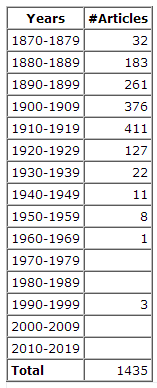 We have compiled over 1,400 newspaper articles that mention the Ligonier Valley Railroad, or related subjects. The articles were originally published starting in 1873 and our collection runs through 1995. Enjoy!
Latrobe Bulletin
Thursday, July 11, 1912
"Reckless" and "Inexcusable" Among The Words Used By Marshal Dohoney, In Reporting On Wreck. Mr. Senft Silent
"Reckless and inexcusable" are among the words used by John P. Dohoney, marshal of the State Railroad Commission, in drawing conclusions from the circumstances
surrounding the Ligonier branch wreck, the conclusions being reached following an investigation made by him upon the ground.
His report was filed with the State Railroad Commission, at Harrisburg, yesterday afternoon and was at once made public.
It is said, at Harrisburg, that the company will be given a reasonable time in which to file answer to the finding of the marshal, and it is further said that should the company be unable to explain away the circumstances cited by the marshal, the attorney general might be asked to consider the institution of prosecution. The report of Dohoney follows:
On July 5, 1912, a collision of a freight and a passenger train occurred on the
Wilpen branch of the Ligonier Valley Railroad, about midway between Ligonier
and Wilpen, causing the death of three employees and a score of passengers and
injuring practically every other occupant of the ill-fated coach.
Your representative on July 7 made a personal investigation of this disaster and
the facts thus obtained led to no other conclusion than that the accident and its horrible consequences were the result of the reckless and inexcusable methods employed in the operation of the line.
These methods not only brought about a collision, but no doubt materially contributed to the number of dead and injured.
The branch with which this report deals is five miles in length, extending from Ligonier to Wilpen.
A passenger coach is operated between these points twice a day. The first trip starts from Ligonier at 6:40 in the morning, and the other from the same place at 3:20 in the afternoon.
At Wilpen there are extensive coal operations, and the product of the mines is brought over the branch to Ligonier and then transferred to its destination.
As a rule, the coal train leaves Wilpen and arrives at Ligonier before noon; but on the day of the accident there was an unavoidable delay, and it was about 3 o'clock in the afternoon when this train, drawn by two engines, was prepared to move.
Order Telephoned.
The freight conductor, H. H. Knox, telephoned from Wilpen to Frank Noel, car
distributor of the Ligonier Valley Railroad Company, who was in the office at
Ligonier, informing him that he was ready to bring in his train and asking
permission to do so before the passenger train left Ligonier for Wilpen. There is but one main track, and it is used for both freight and passenger transportation.
Noel states that General Manager Senft, of the Ligonier Valley Railroad Co., and his assistant, Russell Minnich, were in the room when the message was received from Knox, and that it was decided to permit the freight to come into Ligonier before the passenger train left it.
Minnich was instructed to convey this information to Conductor C. H. Kuhn, of
the passenger train, and he claims he told Kuhn not to move his train until the
freight arrived. It was not a written, but a verbal order, and if the conductor received it, he either misunderstood it or passed it from his mind.
Anyhow, he took out the passenger train, which consisted of one coach and an engine, leaving Ligonier for Wilpen just about the time the freight train left Wilpen for Ligonier.
Noel stated that after he had given the order to hold the passenger train he had some other matters to attend to at a short distance from the station, and while thus engaged the passenger train passed him on the way to Wilpen. He says he was under the impression that the purpose of the conductor was to run the train into a siding but the fact is that this was a disobedience of orders, that the siding was entirely ignored, and that the train was approximately a mile beyond it when the collision took place. There is no evidence to the effect that Noel made any effort to recall the train and by so doing insist upon the compliance with the instructions which he claims to have given for the passenger train to remain at the station until the freight arrived.
The passenger coach, crowded with about 50 men, women and children, was not drawn by the engine, but preceded and was pushed by it, and as the result of this
formation, when the trains came together at a sharp curve in the road, the impact was more disastrous to the coach than if the latter had been in the rear of the locomotive. Cont....