

Ligonier Valley Rail Road Newspaper Articles
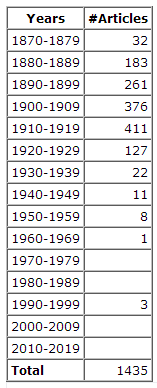 We have compiled over 1,400 newspaper articles that mention the Ligonier Valley Railroad, or related subjects. The articles were originally published starting in 1873 and our collection runs through 1995. Enjoy!
Latrobe Bulletin
Saturday, July 6, 1912
Nineteen Are Dead As Result of Wreck On Wilpen Branch, While Several of the More Than Thirty Injured Are In A Serious Condition
Rhoddy Family Loses Two Little Girls
While Overton Family Is
Almost Wiped Out
Cleaving it in twain for its entire length, a double-engined freight train tore its way through the passenger coach of the afternoon train on the Wilpen branch of the Ligonier Valley Railroad Company, at 3:50 o'clock, yesterday afternoon, and before the day had ended, the record of more than 32 years, without a passenger killed, boasted of by the company, had been blotted out in the blood of nineteen men, women and children, while thirty or more lay in hospital, or in home, suffering from injuries received in what had been the most frightful railroad wreck in the history of Westmoreland county.
Promptly at the scheduled time of departure, 3:45 o'clock, Conductor Charles Kuhn cried "all aboard," and the Wilpen branch train, made up of a combination baggage and passenger car, with an engine pushing it, started upon the journey which was to be attended with disaster so terrible as to stun with horror the community which the train was leaving.
Upon board were fifty or more human souls.
Among them were a number of little children, Louise and Elizabeth Rhoddy, Mary Helen Peters, Bernadetta Andrews, and Billie Brownfield, all of whom has been invited by Miss Esther Mathews, private nurse to General Manager Senft, to go to the woods for flowers. Their childish voices were united in telling of plans for their little outing, and their joy was finding expression in happy laughter. Within five minutes two of them were to be injured so that their deaths became inevitable while the other three were to be
terribly hurt, and all were to be so bruised and blackened that difficulty was to be experienced in identifying them.
Among the passengers were three members of the family of John Overton, happy at the prospect of a speedy arrival home, from a visit over the Fourth. Within five minutes, the mother and a son were to be mortally injured, while another son was to lose a leg.
Among the passengers were two physicians, Drs. Johnson and Hamill, on their way to see their patients, in Wilpen. Within five minutes they were themselves to become patients, with other doctors battling to keep life within them.
Among the passengers were many foreign-born residents, on their way back to their places of employment, following a holiday, spent with friends at a distance, or following a period of shopping, in the town. Within five minutes, some of them were to breathe their last, while others were to be maimed, for life.
Nearly fifty were in the car, and life seemed rosy to the most of them, as Engineer Thomas Dunlap opened the throttle, and started the train upon its way.
Arrived at the sharp curve which is to be found in the branch road, opposite the Morningside race-course, the passenger train began to wind around it, a trainman standing upon the front platform, blowing a whistle as a warning, and the engine pushing steadily, from behind.
Suddenly, but a short distance away, was to be seen approaching the freight train, hauled by two engines, and tearing down the steep grade at a rate of nearly forty miles an hour. Engineer Dunlap, in charge of the passenger engine, saw the other train approach, and as his train was ascending the steep grade, he found it responsive to the brakes, and he succeeded in bringing his engine to a stop, then in reversing it.
But Engineer Smith Beatty, in charge of the first freight engine of the freight, and Engineer Frank McConnaughey who held the throttle on the second engine, found themselves helpless to bring their long train to a stop, and it went crashing into the coach, just as Engineer Dunlap had succeeded in getting his engine stopped.
Literally rending the coach apart, the engines tore their way thru, one side of the wooden car being hurled to the right, and the other side being tossed to the left, mid a crashing of glass and the rending of wood, while the seats and the floor were converted into splinters and patches of velvet which seemed no redder, as they dotted the ground, than did the pools of blood, formed wherever a dead or injured human lay.
Taking the top of the car before it, the engines and the freight continued on their way, for a distance of nearly 200 feet, driving the passenger engine in which were seated Engineer Dunlap and Fireman Walter Byers, before it, but doing no hurt to the two men.
The first of the freight engines finally coming to a stop, the second, still possessed of momentum, careened by it, turning almost completely around, and then toppled over upon its side, carrying the engineer, Frank McConnaughey to the ground, and pinning him beneath its tremendous weight, while the steam from its boilers gushed forth upon him, in a death dealing stream. The fireman, of the second engine, Frank Byers, was thrown from his place, his body landing across the rail, and the tender, coming upon him, cut both legs from his body, the body rolling outside the track, the legs to the other side of the rail.
Smith Beatty, the engineer upon the forward engine, was caught in the wreckage and seriously injured, while his fireman, John Ankney, a son of the veteran rural mail carrier of Latrobe, was hurled to the ground, the wheels of his tender passing over his legs.
Conductor Charles Kuhn of the passenger train, jumped when he saw that a collision was inevitable, and he rolled over upon the ground, his leg broken in two places. Edward Rathmel, the baggageman, also jumped, he being the only occupant of the coach to escape without injury. John Koontz, Francis Koontz, Casper Frye, and Clarence McDowell, members of the freight crew, jumped off and escaped unhurt, all of them being able to turn their attention to the dying and the bleeding lying all about them.
Ezra Nicely, driving by, had witnessed the crash, and whipping up his horse, he bore the news of the awful disaster to Ligonier, while meantime, the uninjured trainmen sought to rescue those buried beneath the wreckage.
It was a terrible sight which lay before their eyes. Not a passenger had escaped unharmed, and all around they lay, bleeding and moaning. The engines had dashed through the coach, as though it had been made of paper, and the passengers, big and little, had been tossed far aside, or buried beneath the mass of splintered wood and twisted steel.
The ground was strewn with wreckage, pieces of the car having been hurled in all directions, while everywhere, seemingly, there were men, moaning in their agony and children screaming with pain. Beneath the prostrate sides of the car, human forms were to be found, struggling, while in the wreckage, others were completely hidden.
From the wrecked engines clouds of steam ascended, while great waves of soot were wafted back upon the dead and injured, its smudge adding to the disfiguration which had resulted when faces and limbs had been sent ploughing through the cinders which surfaced the roadbed, men, women and children having been so blackened that identification became almost impossible in some instances.
The news having been carried to Ligonier, consternation reigned among its people, a perfect frenzy of excitement having been engendered.
The mothers of three of the little children who had gone for flowers were among the guests at a bridge party being held at the home of Mrs. Ford Frank, and the word of the wreck was flashed to them.
"My Mary Helen is on that train," cried Mrs. James F. Peters, the cards dropping from her hand.